Thursday, March 30, 2006

Microcredit

Microcredit is a relatively new form of international aid that helps people from poor countries by giving out small loans to individuals to fund small business. This system started in the 1970s with Muhammed Yunus, an American trained professor of economics, who began giving the first micro-loans in his native Bangladesh. Initial reactions to this enterprise were very negative, with arguments such as the poor would not be able to save or would default on the loans. Today microcredit institutions have overcome those arguments and are now loaning money to five million people. Recently the film Small Fortunes: Microcredit and the Future of Poverty made by BYU’s Center for Economic Self-Reliance aired on PBS and discussed the pros and cons of microcredit.

Businesses funded by microcredit aren’t elaborate by any means, but they allow the receivers of the loans to perhaps double their income. In many cases this takes the receiver from a step away from starvation to a respected and prosperous member of the community. Every month the receiver pays back a portion of the loan with the money they are receiving from their new business.

The loans themselves are small and interest free, so no one is going to make a profit from the business of micro lending, but it has potential to help every poor person who can come up with a business plan. The businesses are things like making market bags out of old cement bags or raising chickens. They are things that don’t require a lot of capital to start, but the people who receive the loans don’t have that little amount of capital to start the business on their own.

This kind of aid is useful because it is not just a handout. The people are required to work hard, give back the money they borrowed, and become self reliant. Surprisingly, almost all the loans do eventually get paid back, even though there is little that the lenders could take away from the receivers if they defaulted on the loan. This system also re-supplies itself so it helps many people, not just a few. The money goes out, comes back in, and can go out again.

Although initially microcredit began by giving loans to both women and men, now about 96% of all the loans at the Grameen Bank and the majority of loans at other institutions are given to women. Lenders found out that women are more likely to actually repay the loans, while the loans to women also have a more direct affect on the family. Women are the primary caregivers to children, so when their situation improves the situation of the children improves as well.

Wednesday, March 29, 2006

Living Maya

The film “Living Maya” was an enlightening portrayal of what it is like to make an ethnographic documentary. The film was essentially a “making of” for the film itself where audience is able to see how the film makers chose their site, enter the field, and interact with the people they film. I really enjoyed seeing the behind the scenes work that goes into making a very low budget ethnographic film like this. It gave me insight into what really goes on and reminded me of what happens when anthropologists go out into the field to study other cultures.

The film makers had an idea of what kind of village they wanted to film, so they talked with their friends about the villages in the Yucatan. They then spent several weeks driving around to different villages to see which one was the best one. When they found the village they wanted to work in they gathered the men together (the women weren’t allowed to attend the meeting) and asked for permission to make a film there.

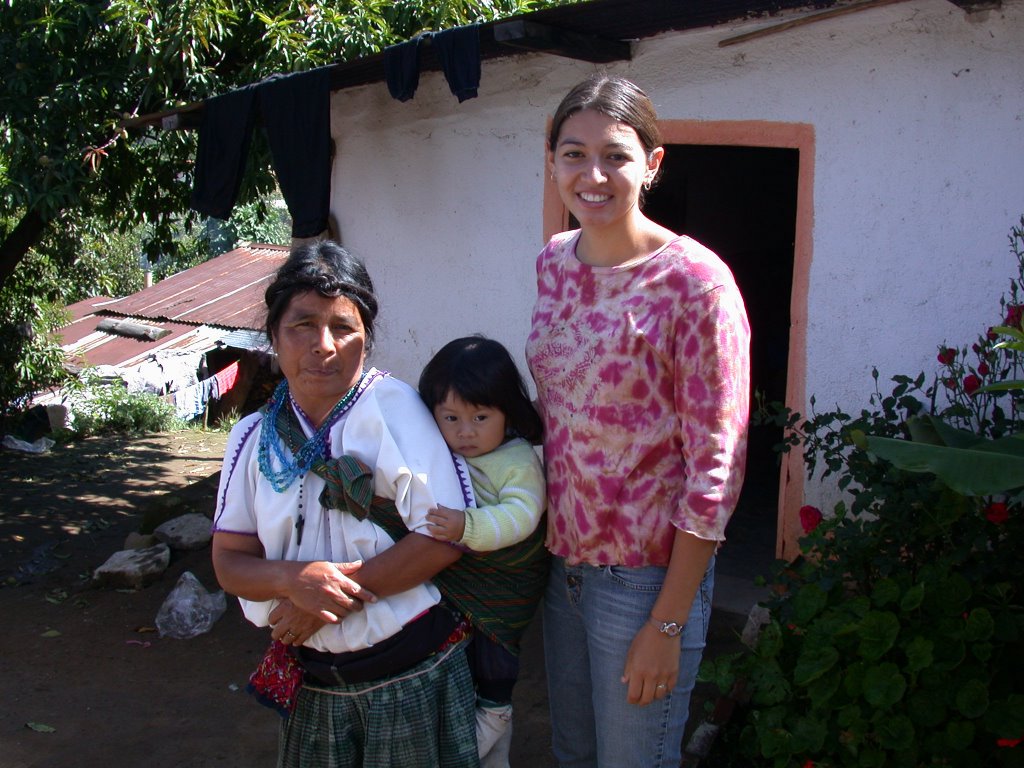
This reminded me a lot of when I went to Guatemala. The town that I studied in had BYU students coming there for 10 years. I was a pretty pampered anthropologist in that regard. The people knew what I was there for and were pretty willing to talk to me. The year I went however,the field facilitator put one student in a small, very remote town where no BYU students had ever stayed. Professor Hawkins went up there with the student and asked around if they would allow the student to stay. The family they talked to said that they would have to have a town meeting about it, but he could stay there in the meantime. A few days latter they came up to him and told him that he could stay.

I also really liked the part of the film where the women are talking about the filmmaker in the kitchen, with him right there. The women are speaking in Mayan so the filmmaker doesn’t know what they are saying, but someone went back and translated it and put in subtitles so the audience can tell what is going on. I know this happened to me everyday while I was in Guatemala. I was able to tell from my limited Maya capabilities a little of what was going on, but when I asked they would deny that they were talking about me. So I thought the film was very realistic with what it portrayed.

Tuesday, March 21, 2006

Hear Yourself

Today I stumbled upon the Inquiry Conference site and found that the audio for the 2006 presentations is now available online. Feeling somewhat curious, but a little aprehensive, I scrolled down the page and clicked on my own presentation. It was a very weird feeling to hear myself giving a presentation. It's not like hearing someone else give a presentation because all the memories come rushing back. Even though I was just listening, I was not an idle bystander. I felt like I was back up there, nervous and frustrated with myself for not being able to get the words out right. (When I got up to give my presentation my words just wouldn't come out. I stumbled and pronounced words wrong.) Listening to myself on audio recording was really just too much for me because I felt like I was giving the presentation again. I couldn't do it, so I stopped listening.

You can listen to the presentation at http://kennedy.byu.edu//events/inquiryconf.php.

Sunday, March 12, 2006

Computer Meltdowns

My laptop has been acting really weird latelty. I will turn it on and it will be fine for a while, and then the screen will go black. I figured out that if I shine the desk lamp onto the screen I can see what is there. So the lights go out I guess. Last week Rob opened his laptop and the plastic around the screen broke, so he can't close it anymore. Then yesterday he tried to use his computer and it wouldn't let him open any programs. He opened it in safe mode and was able to move most of his files onto an external harddrive. This afternoon he spent an hour and a half on the phone with Dell customer service, but so far nothing has happened. Luckily, we still have our desktop computer, which besides from being old, is usable. Rob tried to turn it on yesterday and it wasn't turning on. Then I noticed that the screen and the printer had power, so I suggested that he check the power cord on the tower. Yup, it was just unplugged.

Thursday, March 02, 2006

Inquiry Conference

This is it. Today is the day of the Inquiry Conference. In three short hours it will all be over. Will I have made it through alive? Well, most likley. I am really nervous about it though, and am doing my best to go through my presentation so I know what I am doing when I get up there. It's just so surreal. It is one of those feelings of "I can't beleive this is finally happening." Like when you get married, and you're like, wow, I'm getting married. This is on a much smaller scale, but feel like, "wow, I'm presenting at the Inquiry Conference." Wish me luck!

Sunday, February 26, 2006

An Interview and A Talk

I had my interview with Reading to Kids on Friday. It went really well. I enjoyed talking to Jessica, the program director, and finding a little about how the program works. At the end of the interview she told me that she would like to have me intern with them this summer and I told her I would love to intern. So I just need to send in a writing sample this week so she knows what kind of writer I am. A lot of running a non-profit group involves fundraising and grant writing, so I will be doing a lot of that. I really think right now that working for non-profit groups would be something I would like doing as a career. I have thought about getting an MSW(Masters of Social Work) or an MPA (Masters of Public Administration). In non-profit work everyone does a lot of everything, so someone who is well rounded is something that they look for. I have hope that my experience interning with Reading to Kids will give me a leg up on the competition for non-profit jobs in Utah, since I will have experience in all aspects of non-profit work.

On Thursday I got a call from one of the counselors in the Bishopric. He started out “I know this is short notice so you can say no if you want to…” You always know what’s coming after that. He asked me to talk about receiving personal revelation in sacrament meeting on Sunday. I had things that I had to get done on Saturday, that didn’t get done, but at least I have given a talk in church now and I won’t have to worry about it for another while. Plus, the three day notice didn’t give me very much time to worry about it.

This morning Robert and I woke up at the same time. I started getting ready for church and Robert got a bowl of cereal and went straight to his computer. At about twenty minutes until church started Robert had still not started getting ready, so I told him “You know, we actually have to be on time for church today.” He started to get ready then, and he had to finish putting on his tie and tying his shoes in the car. He says that he puts getting ready of until the last minute because then he wastes as little time as possible getting ready. If he only has ten minutes to get ready, then he will only take ten minutes. If he starts an hour earlier though, it will take him an hour.

My talk went well. The last time I had to talk in church I couldn’t see the clock, so I went over, and then everyone else had to cut their talks short. So this time I made sure I could see the clock and I finished in about ten minutes. I also tried to talk slowly, because I notice that when I get up and talk to people I usually get nervous and talk really fast. Robert said that it didn’t seem like I talked too fast, but that I did say umm too many times. I know I have to work on that. I need to give my presentation to Robert and have him throw a water balloon at me every time I say umm.

Tuesday, February 21, 2006

"They are all my Children"


Tojo papi, tojo amor,” Juana playfully beckoned her young grandson from across the kitchen. The child glanced over at her, but instead toddled towards the plancha, the ceramic stove, aiming directly for the fire. Once there he proceeded to play with the ash emerging from the front of the plancha. The family, however, looked on unconcerned and continued their conversation about how many cows to buy in the market the next day. Suddenly Miguel, the grandfather, lunged forward shouting “no, no, no!” as he confiscated a flaming stick from his young grandchild. “Ai hombre!” the child’s exasperated mother exclaimed as she stood and took the mischievous toddler from his grandfather.

My research took me to the small K’iche’ Maya town of Antigua Santa Catarina Ixtahuacan (ASCI) in Guatemala where most families live in family compounds where the normal dinner conversation consists of interactions like this between three generations of family members. Families are constantly together, speaking to one another and building relationships in day-to-day activities. I first arrived in Guatemala expecting to study the bond between grandparents and grandchildren. However, as I studied I realized that the bond between grandparent and grandchild is a cornerstone for the eldercare system. In my research I established the importance of grandparent/grandchild relations among the K’iche’ by examining children as a remembrance of their grandparents and grandparents as parents. Next, I looked at the significance of showing respect in Maya ideology and then examined the factors contributing to loss of respect. I show that the eldercare system among the K’iche’ relies on a strong bond in grandparent/grandchild relations as exhibited by respect towards grandparents. Without this bond the eldercare system, based on kinship care giving, can no longer function effectively

My research was conducted using semi-structured interviews with informants of all ages with the help of a Spanish/K’iche’ translator, as well as participant observation of everyday life in ASCI. Some of my most valuable participant observation actually happened during interviews where I witnessed, for example, family fights and grandmothers breastfeeding grandchildren. The cultural information I learned from observing the family may actually in these instances have been more significant than the information from the actual interview. I also completed a survey of forty households in ASCI in collaboration with all the students in our group conducting research in surrounding villages.

Grandparents are key figures in the lives of their grandchildren because grandparents traditionally act as backup parents for grandchildren when grandchildren are young. This nurturing relationship not only extends from grandparents to their grandchildren, however. After both grandparent and grandchildren have grown and grandparents can no longer take care of themselves then grandchildren have a responsibility to care for their grandparents, just as the grandparents had once cared for their grandchildren.

Grandparents are also distinctively important in K’iche’ culture because respect for ancestors is so prominent in Mayan ideology. Respect towards grandparents may act as an extension of this idea since grandparents can be seen as living ancestors. One of the most visible sign of this in ASCI is the k’ex bond between grandparents and grandchildren, which literally means “substitute” (Mondloch 1980:10). K’iche’ naming practices name children after their grandparents. Consequently, children named after their grandparents become grandparents’ k’ex, their replacement. This continuous cycling of a name ensures that the ancestor is never forgotten. Aspects of k’ex can be found in regions around the Maya world, such as Momostenango, San Andres Semetebaj, and even into Chiapas, Mexico (Mondloch 1980, Carlsen and Pretchel 1991), though few studies have examined k’ex in any detail.

These two concepts in Mayan ideology, respect for ancestors and k’ex, reinforce the pattern of nurturing between grandparents and grandchildren. These create a system where all members of the society are taken care of. The cultural system is dynamic, however, and culture change from Ladino (non-indigenous Guatemalans) and Western influences has put the eldercare system in danger of breaking apart. Instead of remaining in the community to take care of the elderly, many young people leave the communities.

Televisions, once a rarity in ASCI, have been bought recently by many people in the village. This has chiefly allowed K’iche’ youth to see beyond their borders and yearn for things they see on these televisions. Furthermore, K’iche’ youth have become familiar with Ladino pop culture and music and often times become overly preoccupied with them. They no longer value Mayan ideals such as respect towards the elderly. Two ways to get the material things are by becoming more educated or by migrating. Both of these require that the youth leave the village. Furthermore, if the youth do stay in the community, many of them are unconcerned with making sure their grandparents are taken care of.

One of the many problems these create is that the system to care for the elderly is left with many holes. Grandchildren would rather spend their time trying to make money or catching up with the latest fashion than taking care of their grandparents. In Guatemala there is no state system in place to take care of the elderly if their family fails them. The spread of western ideals and western products around the globe should also come with an understanding and preservation of native cultures and social systems. Without this, cultures that have methods for things like health care and discipline that have been successfully used for centuries will face major social problems if they cannot adapt quickly enough. Further research should be done into the health care system for the Maya elderly before more elderly are inadvertently abandoned by their kin without other support systems.